How to Prepare for a Job Interview
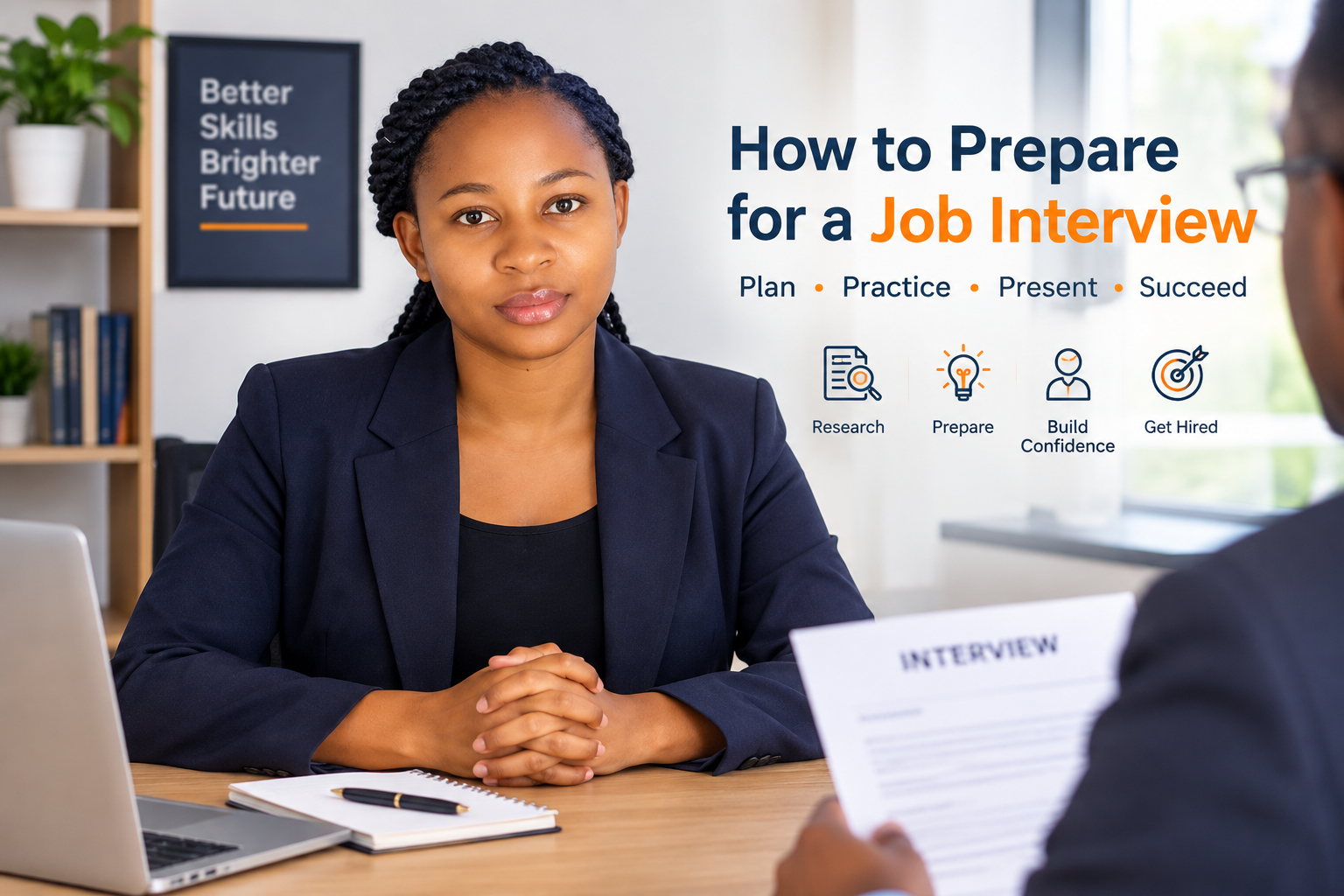
Getting invited for a job interview is an important step in your career journey, but receiving an invitation does not guarantee getting the job. How you perform during the interview can determine whether you move to the next stage or receive an offer.
Proper preparation can help you communicate your skills clearly, reduce nervousness, and make a strong impression on the interviewer.
Here are practical steps to help you prepare for a job interview.
Understand the Job Description
Before attending an interview, carefully read the job description.
Understand the responsibilities, qualifications, experience, and skills the employer is looking for. Identify the areas where your experience and skills match the requirements.
This will help you explain why you are suitable for the position.
Research the Organization
Take some time to learn about the organization before the interview.
Find out what the organization does, the products or services it provides, its values, and the type of customers or clients it serves.
Good research will help you answer questions more confidently and show the interviewer that you are genuinely interested in the organization.
Review Your CV
Interviewers often ask questions based on information contained in your CV.
Review your education, previous employment, skills, projects, achievements, and responsibilities before the interview.
Be prepared to explain anything you have included in your CV.
Most importantly, never include information you cannot confidently explain.
Prepare for Common Interview Questions
Practice answering common interview questions such as:
Tell us about yourself.
Why do you want to work with us?
Why should we hire you?
What are your strengths?
What is your weakness?
Where do you see yourself in five years?
Why did you leave your previous job?
What salary are you expecting?
Practising your answers can help you communicate more clearly during the actual interview.
Prepare Examples From Your Experience
Whenever possible, support your answers with real examples.
Instead of simply saying that you are a good problem solver, explain a situation where you identified a problem, took action, and achieved a positive result.
Real examples make your answers more convincing.
Prepare Questions for the Interviewer
An interview should not only be about answering questions. You should also have thoughtful questions for the interviewer.
For example:
What would be my main responsibilities in this position?
What does a typical working day look like?
What qualities are you looking for in the successful candidate?
Are there opportunities for professional development?
Having questions prepared shows that you are interested in the role and the organization.
Dress Appropriately
Your appearance contributes to the first impression you make.
Choose clean, neat, and appropriate clothing that matches the organization and position you are applying for.
You do not necessarily need expensive clothing. What matters most is that you look professional, presentable, and confident.
Plan Your Journey
Do not wait until the interview day to figure out how you will get to the location.
Know the address and estimate how long the journey will take.
If possible, plan to arrive 10 to 20 minutes early. This gives you time to settle down and prepare yourself before the interview begins.
Practice Your Introduction
Your introduction is often one of the first things the interviewer will ask about.
Prepare a short and professional introduction that explains who you are, your background, your relevant experience, and what you can bring to the organization.
Avoid memorising a long speech. Your introduction should sound natural.
Communicate With Confidence
During the interview, speak clearly and confidently.
Maintain reasonable eye contact, listen carefully to each question, and take a moment to think before answering difficult questions.
You do not have to rush your responses.
Confidence does not mean pretending to know everything. It means being able to communicate your abilities honestly and professionally.
Be Honest
Never lie about your qualifications, experience, skills, or previous employment.
If you do not know the answer to a question, it is better to acknowledge it honestly and explain how you would approach learning or solving the problem.
Employers value honesty and a willingness to learn.
Prepare for Salary Discussions
Some employers may ask about your salary expectations during the interview.
Research the typical salary range for similar positions and consider your experience, skills, responsibilities, and location.
Avoid giving an unrealistic figure without understanding the role.
You can also ask about the organization's overall compensation package, including allowances, bonuses, training opportunities, and other benefits.
Control Interview Anxiety
It is normal to feel nervous before an interview.
Prepare properly, get enough rest, arrive early, and take a few deep breaths before entering the interview room.
Remember that an interview is a conversation about whether your skills and experience are a good match for the position.
You do not need to be perfect.
Learn From Every Interview
Not every interview will result in a job offer.
If you are unsuccessful, use the experience as an opportunity to improve.
Think about the questions you struggled with, the areas where you lacked confidence, and what you could do differently next time.
Every interview can help you become better prepared for the next opportunity.
Common Interview Mistakes to Avoid
Avoid arriving late.
Do not speak negatively about previous employers.
Do not exaggerate your skills or experience.
Do not interrupt the interviewer.
Do not use your phone during the interview.
Do not appear uninterested in the position.
Do not give unnecessarily long answers.
Do not ask only about salary and benefits.
Do not forget to research the organization.
A Simple Interview Preparation Checklist
Before your interview, make sure you have:
Reviewed the job description.
Researched the organization.
Reviewed your CV.
Prepared answers to common questions.
Prepared examples from your experience.
Prepared questions for the interviewer.
Selected appropriate clothing.
Confirmed the interview location or online meeting details.
Planned your journey.
Prepared important documents.
Got enough rest before the interview.
Conclusion
Preparing for a job interview is not something you should do a few minutes before entering the interview room. Good preparation starts from the moment you apply for the position.
Research the organization, understand the role, review your CV, practise your answers, dress appropriately, and approach the interview with confidence and honesty.
Remember, an interview is not only an opportunity for an employer to evaluate you. It is also an opportunity for you to determine whether the organization and the position are right for your career goals.
The more interviews you attend and learn from, the more confident and prepared you will become.
💬 Comments
No comments yet. Be the first to comment!
← Back to Blog📚 Related Articles
School Administration Software
Managing a school manually can be time-consuming. As the number of students, teachers, and administr...
Read More →
From Idea to Product: Our Software Development Process
From Idea to Product: Our Software Development ProcessEvery successful software product begins with...
Read More →
The Importance of Education in Modern Society
Education is one of the most powerful forces for personal growth and societal progress. It equips pe...
Read More →
The Pain of Helping Everyone While Nobody Helps You
The Pain of Helping Everyone While Nobody Helps YouHave you ever been the person everybody remembers...
Read More →
The Struggle of Being Misunderstood
The Struggle of Being MisunderstoodHave you ever tried so hard to explain yourself, yet somehow your...
Read More →
Fighting Battles Nobody Knows About
Not every battle comes with visible wounds. Not every struggle announces itself, and not every perso...
Read More →