Marital Reconciliation: Can a Marriage Be Rebuilt After Deep Hurt?
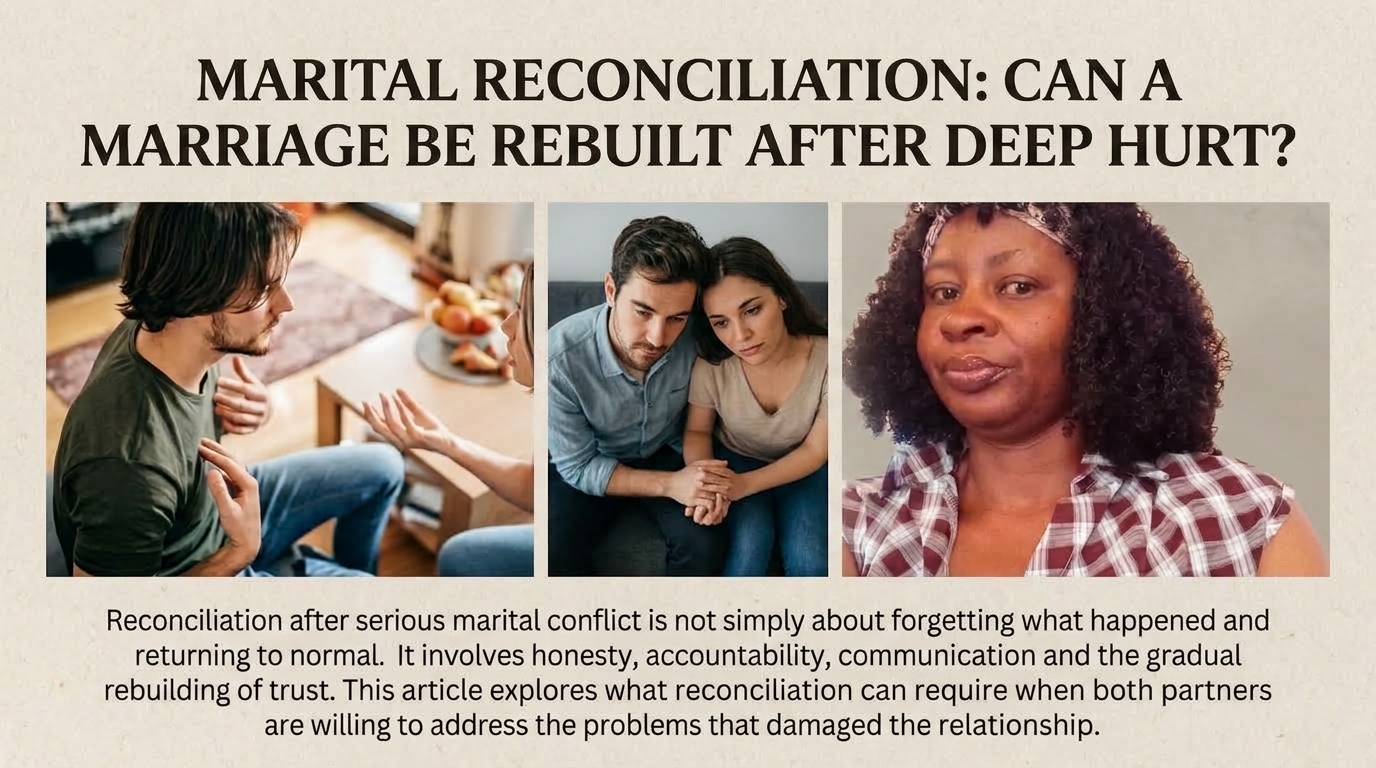
Marital Reconciliation: Can a Marriage Be Rebuilt After Deep Hurt?
Marriage can go through seasons of joy, disagreement, disappointment and pain. Some conflicts are resolved through ordinary communication, while others leave deep wounds that can change the way spouses see one another. Betrayal, dishonesty, financial difficulties, repeated conflict, emotional distance, interference from extended family and other serious problems can place enormous pressure on a marriage.
When a marriage has been deeply hurt, one important question often arises: Can the relationship be rebuilt?
In some circumstances, reconciliation is possible. However, reconciliation is not simply about pretending that nothing happened or returning to the way things were before the conflict. Genuine reconciliation requires both partners to be willing to understand what went wrong, take responsibility for their actions, communicate honestly and work toward rebuilding trust.
What Does Marital Reconciliation Actually Mean?
Marital reconciliation is the process of repairing a damaged relationship and restoring a meaningful connection between spouses.
It involves more than ending an argument or deciding to remain married. A couple may continue living together while remaining emotionally distant, resentful or distrustful. Reconciliation goes deeper by addressing the underlying issues that caused the damage.
This may involve:
Acknowledging what happened
Taking responsibility for one's actions
Listening to the hurt partner
Expressing genuine remorse where appropriate
Establishing healthier communication
Rebuilding trust gradually
Addressing the causes of repeated conflict
Establishing boundaries where necessary
Creating new patterns for the relationship
Reconciliation is therefore better understood as a process rather than a single decision.
Forgiveness, Reconciliation and Returning to the Same Relationship
These three ideas are often treated as though they mean the same thing, but they are different.
Forgiveness involves releasing resentment or choosing not to remain controlled by the wrong that was committed. Forgiveness can be deeply personal, and a person may choose to forgive even when the relationship has not been restored.
Reconciliation involves rebuilding a relationship between two people. It requires participation from both sides because one person cannot completely reconcile a relationship alone.
Returning to the same relationship may simply mean resuming the relationship without addressing the problems that caused the breakdown.
That distinction matters.
A couple can decide to remain together without resolving the underlying issues. In such a situation, the relationship may appear restored on the outside while the same problems continue underneath.
Healthy reconciliation seeks to address the problems rather than simply covering them up.
What Can Cause a Marriage to Break Down?
Marital breakdown rarely has only one possible cause. Different relationships experience different challenges, and problems can develop gradually over time.
Some common sources of marital conflict include:
1. Poor Communication
When spouses stop communicating openly, misunderstandings can accumulate. Small disagreements can become larger problems when neither person feels heard or understood.
2. Betrayal
Infidelity, dishonesty and other forms of betrayal can seriously damage trust. The emotional consequences may remain long after the original incident.
3. Financial Pressure
Differences in spending habits, debt, financial secrecy or disagreements about financial responsibilities can create significant tension within a marriage.
4. Emotional Distance
A couple may remain physically together while becoming emotionally disconnected. When affection, attention and meaningful conversation gradually disappear, loneliness can develop within the marriage.
5. Unresolved Conflict
Every marriage experiences disagreement. The problem can become more serious when conflicts are repeatedly ignored, avoided or handled through insults, threats or hostility.
6. Family and External Pressure
Extended-family expectations, work pressures, social pressures and other outside influences can sometimes contribute to marital difficulties, particularly when spouses struggle to establish appropriate boundaries.
7. Unmet Expectations
Spouses may enter marriage with different expectations about finances, parenting, household responsibilities, intimacy, career development, faith or relationships with extended family.
The important question is not always, "Who is to blame?" Sometimes the more productive question is, "What happened, and what needs to change?"
Honesty Is Essential to Reconciliation
A marriage cannot be meaningfully rebuilt on continued deception.
If serious problems have occurred, reconciliation may require difficult conversations about what happened. Avoiding uncomfortable truths may provide temporary peace, but it does not necessarily repair the underlying damage.
Honesty can involve admitting mistakes, answering difficult questions, acknowledging the consequences of one's actions and being willing to hear how one's behaviour affected the other person.
However, honesty should not be confused with deliberately saying things to hurt or humiliate a spouse. The purpose of honest communication should be understanding and repair, not punishment.
Accountability Goes Beyond Saying "I'm Sorry"
An apology can be important, but genuine accountability usually involves more than words.
For example, a spouse who has repeatedly behaved dishonestly may need to demonstrate through consistent actions that the behaviour has changed.
Accountability may include:
Accepting responsibility without constantly shifting blame
Acknowledging the impact of one's actions
Making appropriate changes
Keeping commitments
Being transparent where transparency is necessary
Accepting reasonable consequences
Demonstrating change consistently over time
Trust is often rebuilt through repeated evidence of reliability rather than through one emotional conversation.
Rebuilding Trust After Betrayal
Trust can be one of the most difficult things to rebuild after serious marital hurt.
When trust has been damaged, the injured spouse may have questions, doubts or fears. Expecting everything to return to normal immediately may create additional frustration.
Rebuilding trust can take time.
The spouse who caused the harm may need to demonstrate consistency, honesty and patience. The hurt spouse may also need time to process what happened and decide what boundaries are necessary.
Rebuilding trust does not mean constantly investigating or punishing one another. Instead, it involves creating conditions in which both partners can gradually feel secure in the relationship again.
Communication After Serious Conflict
Communication becomes especially important after a major disagreement or betrayal.
Couples may need to learn how to discuss difficult subjects without immediately becoming defensive or hostile.
Helpful communication can include:
Listening before responding
Allowing each person to explain their perspective
Avoiding insults and name-calling
Discussing one issue at a time
Speaking about feelings without using them as weapons
Taking a break when a conversation becomes overwhelming
Returning to the conversation when both people are calmer
Sometimes the goal of the first conversation should not be to solve everything.
It may simply be to understand what happened and allow both people to be heard.
Reconciliation Requires Willingness From Both Partners
One of the most important realities about reconciliation is that one person cannot rebuild a marriage alone.
One spouse may sincerely want to repair the relationship while the other is unwilling to participate. A person can take responsibility for their own behaviour, communicate honestly and make positive changes, but they cannot force another person to trust them or resume emotional closeness.
Both partners need some level of willingness to examine the relationship and consider what needs to change.
This does not mean both spouses must heal at the same speed. One person may need more time than the other. What matters is that there is a genuine willingness to work toward healthier patterns.
When Professional or Spiritual Guidance May Help
Some marital problems are difficult for couples to resolve without outside assistance.
Marriage counselling or another qualified professional may provide a structured environment where both spouses can communicate and examine recurring patterns.
Trusted spiritual guidance may also be valuable for couples whose faith plays an important role in their marriage. A responsible spiritual adviser can provide encouragement and perspective while recognising when professional counselling or other specialised support is also necessary.
Seeking help is not necessarily a sign that a marriage has failed. Sometimes it is an acknowledgment that the problem is significant enough to require additional support.
Reconciliation Does Not Mean Ignoring Abuse
There is an important distinction between ordinary marital conflict and abuse.
Where there is physical violence, sexual abuse, coercive control, threats, intimidation or other serious forms of abuse, the priority should be safety, not simply restoring the relationship.
A person experiencing abuse does not have to place themselves in danger in order to prove forgiveness or commitment to reconciliation.
Safety planning, appropriate professional support and trusted assistance may be necessary. In situations involving immediate danger, seeking emergency help and moving to a safe environment may be more important than attempting to resolve the marital disagreement.
Boundaries are also important. Reconciliation should not require someone to accept continued harmful behaviour.
Rebuilding a Marriage May Require Building Something Different
One misconception about reconciliation is that the goal is always to return to exactly how the marriage was before the conflict.
Sometimes that is neither realistic nor desirable.
If the previous patterns contributed to the breakdown, simply returning to them may eventually produce the same problems.
Reconciliation may instead involve building a healthier version of the relationship—one with clearer communication, stronger boundaries, greater honesty and a better understanding of each spouse's needs and responsibilities.
The marriage may look different after healing, but different does not necessarily mean worse. It can mean that the couple has learned from what happened and developed healthier ways of relating to one another.
Conclusion
Marital reconciliation after deep hurt can be difficult, and it should not be reduced to simply saying, "Let's forget what happened."
Forgiveness, accountability, honest communication and the rebuilding of trust can all play important roles. However, reconciliation is a process, and it requires genuine willingness from both partners.
Some marriages can recover from serious conflict when both spouses are prepared to confront the underlying problems and work toward meaningful change. Others may require professional or spiritual guidance, stronger boundaries or significant time apart before the future of the relationship becomes clearer.
Ultimately, reconciliation should not be about returning to appearances. It should be about creating a relationship in which honesty, respect, accountability, safety and mutual commitment can exist.
Deep hurt does not automatically mean that a marriage cannot be rebuilt. But rebuilding requires more than love alone. It requires willingness, responsibility, patience and consistent action from both partners.
💬 Comments
No comments yet. Be the first to comment!
← Back to Blog📚 Related Articles

Who Do You Call Your Friend? Who Is the Third Person in Your Marriage?
Marriage is designed to bring two people together to build a life, share responsibilities, make deci...
Read More →
Silence in Marriage: Causes, Consequences and Solutions – The Hidden Marriage Killer
Silence in Marriage: Causes, Consequences and Solutions – The Hidden Marriage KillerMarriage is expe...
Read More →
15 Types of Women Men Should Be Careful About Choosing as Wives
15 Types of Women Men Should Be Careful About Choosing as WivesMarriage is one of the most significa...
Read More →
15 Types of Men Women Should Be Careful About Choosing as Husbands
15 Types of Men Women Should Be Careful About Choosing as HusbandsMarriage is more than falling in l...
Read More →
When “We’ll Stop” Stops Working: Why Couples Cross Their Own Sexual Boundaries
Relationships built on clear values often run into a frustrating paradox: decision-making is clear i...
Read More →
7 Essential Topics Couples Must Discuss Before Marriage (Beyond Physical Intimacy)
Entering a life-long partnership is one of the most exciting milestones standard in adult life. Whil...
Read More →