AI vs Traditional Software: What's the Difference?
Technology has changed the way businesses operate. Today, businesses can choose from traditional software applications, artificial intelligence solutions, or a combination of both.
But what exactly is the difference between AI and traditional software?
While both can automate tasks and improve business operations, they approach problems differently.
What Is Traditional Software?
Traditional software is generally designed to follow predefined instructions.
For example, a business management system may be programmed to:
Record customer information
Calculate sales totals
Manage inventory
Generate invoices
Process orders
Create reports
Manage employee records
The software follows rules defined by the developer.
For example:
If stock quantity is below 10 → display a low-stock warning.
The system does not need to "learn" why the stock is low. It simply follows the programmed rule.
What Is Artificial Intelligence?
Artificial intelligence allows software to perform tasks that normally require some form of human-like intelligence.
Depending on the system, AI can be used to:
Analyze large amounts of data
Recognize patterns
Generate text or images
Understand natural language
Make predictions
Recommend products
Classify information
Assist with decision-making
For example, an AI-powered system could analyze previous sales data and identify products that are likely to sell more during a particular period.
Key Difference Between AI and Traditional Software
The simplest way to understand the difference is:
Traditional software primarily follows predefined rules.
AI systems can use data, models, and learned patterns to produce predictions, classifications, recommendations, or generated content.
However, the distinction is not always absolute. Modern applications can combine traditional programming with AI features.
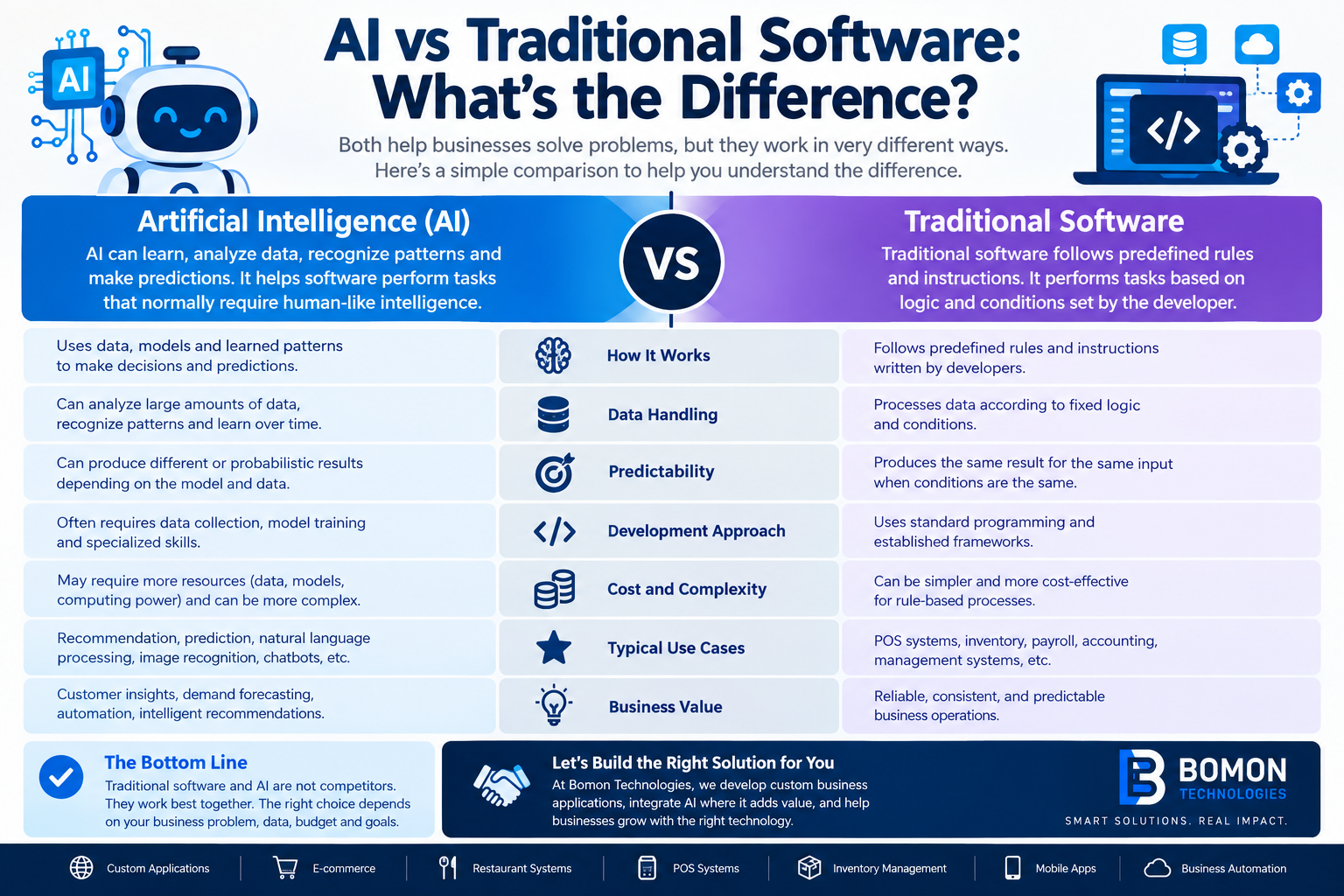
AI vs Traditional Software
Feature | Traditional Software | AI-Based Software |
|---|---|---|
Rules | Mainly predefined | Can learn patterns from data |
Decision-making | Based on programmed logic | Can use models and predictions |
Data requirements | Often relatively predictable | Often benefits from large datasets |
Adaptability | Changes require programming | Some systems can adapt through training or updated models |
Automation | Rule-based automation | Can automate more complex or variable tasks |
Output | Usually predictable | Can be probabilistic or variable |
Examples | POS, inventory, payroll | Chatbots, recommendations, forecasting |
1. How They Handle Data
Traditional software generally processes information according to instructions written by developers.
For example, an inventory application might calculate:
Current stock = Previous stock + Purchases − Sales
AI systems can go further by analyzing historical data to identify patterns.
An AI model could potentially analyze:
Previous sales
Seasonal demand
Customer behavior
Product popularity
Pricing
Purchasing trends
and use those patterns to generate a forecast.
2. Predictability
Traditional software is generally more predictable.
If the same input is processed using the same rules and conditions, the application will normally produce the same result.
AI systems can produce different or probabilistic outputs depending on the model, data, configuration, and task.
This is one reason AI applications require careful testing and monitoring.
3. Development Approach
Traditional software development typically involves:
Requirements → Design → Programming → Testing → Deployment → Maintenance
AI development may involve additional stages:
Data collection → Data preparation → Model selection/training → Evaluation → Integration → Monitoring
This means AI projects can require specialized skills in addition to traditional software development.
4. Cost and Complexity
Traditional software can often be simpler to develop when the business requirements are clearly defined.
For example, a small business may need a system that manages:
Customers
Products
Sales
Inventory
Employees
A conventional application may be sufficient.
An AI solution can require additional resources such as:
Quality data
AI models
Specialized development
Computing resources
Testing
Model monitoring
Therefore, businesses should not add AI simply because it is popular.
5. When Traditional Software Is the Better Choice
Traditional software is often appropriate when a business needs predictable, rule-based processes.
Examples include:
POS systems
Inventory systems
Payroll systems
School management systems
Hospital record systems
Accounting applications
Appointment systems
Restaurant ordering systems
For these applications, clear rules and reliable data processing may be more important than AI.
6. When AI May Be the Better Choice
AI can be particularly useful when the business needs to work with complex or unstructured information.
Examples include:
Customer-service chatbots
Demand forecasting
Fraud detection
Recommendation systems
Document classification
Natural-language search
Predictive analytics
Image recognition
AI can add significant value when the problem involves identifying patterns or generating useful predictions.
7. Businesses Can Use Both
AI and traditional software do not have to compete.
In many modern business applications, they work together.
For example, consider an e-commerce platform.
Traditional software can handle:
Customer → Product → Cart → Payment → Order → Inventory
AI can then provide additional capabilities such as:
Product recommendations → Customer insights → Demand forecasting → Automated support
This combination can produce a more powerful business application.
Example: Restaurant Ordering System
A restaurant ordering application can use traditional software to:
Display menus
Receive orders
Calculate prices
Process payments
Track order status
Update inventory
AI could later be added to:
Recommend meals
Analyze customer preferences
Forecast demand
Assist customer support
Analyze sales patterns
The traditional application provides the operational foundation, while AI adds intelligent features.
Should Every Business Use AI?
No.
Businesses should first identify the problem they are trying to solve.
If a simple rule-based application can solve the problem effectively, adding AI may introduce unnecessary cost and complexity.
AI is most valuable when it solves a problem that traditional programming cannot handle as efficiently or effectively.
How Bomon Technologies Approaches Business Software
At Bomon Technologies, we believe technology should solve real business problems.
We develop solutions such as:
Custom business applications
Laravel applications
POS systems
Inventory management systems
Restaurant ordering platforms
E-commerce solutions
Mobile applications
Progressive Web Apps
Business automation systems
Where appropriate, AI capabilities can also be incorporated into business applications to provide features such as intelligent recommendations, data analysis, automation, and decision support.
Conclusion
AI and traditional software are not necessarily alternatives.
Traditional software remains extremely valuable for structured, predictable business processes, while AI can provide additional capabilities when businesses need pattern recognition, predictions, natural-language processing, recommendations, or other intelligent functionality.
The right choice depends on the business problem, available data, budget, technical requirements, and long-term goals.
Instead of asking, "Do we need AI?", businesses should first ask:
"What problem are we trying to solve, and what is the most effective technology for solving it?"
That question can lead to better technology investments and more sustainable digital transformation.
💬 Comments
No comments yet. Be the first to comment!
← Back to Blog📚 Related Articles

Bootstrap and Templates for Developers: Build Websites Faster
Bootstrap and Templates for Developers: Build Websites FasterBuilding a website from scratch can tak...
Read More →
The Use of Technology to Wipe Off Local Techniques
Technology has become a major force in the development of modern society. It has changed the way peo...
Read More →
Implementing and Evaluating the Effectiveness of Zero Trust in Society
Technology has become an essential part of modern society. People use digital platforms for banking,...
Read More →
Common Laravel Errors and How to Fix Them
Laravel makes modern PHP application development faster and more structured. However, like any softw...
Read More →
Essential Skills Every Professional Should Develop
The workplace is constantly changing, and professionals are expected to do more than simply have aca...
Read More →
Why Small Businesses Need Custom Software
Small businesses are increasingly using technology to improve the way they operate. However, many bu...
Read More →